
CRITICAL LEGAL THINKING
LAW AND THE POLITICAL
CRITICAL LEGAL THINKING
LAW AND THE POLITICAL

Militant Democracy as Neurosis
Walter Benjamin invites us to think language in a radically different way: not as a neutral medium of communication, but as something living, something creative. For him, language is not exclusively human: everything that exists speaks. It may do so through gesture, through form, or simply through presence. In short, everything expresses itself. Humanity occupies a distinctive position within this field: human beings do not merely speak, they are capable of naming – and in naming, they bring the world into being. Act of Creation Benjamin therefore reads the Book of Genesis as a moment of linguistic philosophy: “And God said, ‘Let there be light,’ and there was light” (Gen. 1:3). In the Gospel of John, this linguistic act is rendered even more explicit: “In the beginning was the Word” (John 1:1). The Word is the point of origin of all things. Naming, then, is not simply descriptive; it is world-making (Benjamin 1977, 140-157). In other words, naming draws things out of the unnameable…


ARTICLES

The Irish Referendum: Fear Prevails
The result of the referendum on the Fiscal Treaty that took place yesterday in Ireland was a Yes in favour of the constitutional change that allows the neoliberal measures contained in the Treaty to implemented. There was a very low level of participation: around 50%…

Anorexia and the Political
Stretched across the critique: have we lost connection with each other? Have we lost a sense of grounding as critical legal scholars? However we frame this question, it goes to the heart of a fear that critical thought is not in touch with any reality. Some paper…

The legal market has its Lehman Bros. moment
As partners and associates of 190 equity partner US law firm Dewey & LeBoeuf filed out of their 6th Ave. New York office, cardboard boxes of desk clutter in hand, one could not help noticing the similarities with the images of the collapse of Lehman Bros. The…

SYRIZA Proposal: The Exit from the Crisis on the Left
1. Creation of a shield to protect society against the crisis • Not a single citizen without a guaranteed minimum income or unemployment benefit, medical care, social protection, housing, and access to all services of public utilities. • Protection of and relief…

Private Legal Transplants: Bright and dark nature of an unnoticed phenomenon
Only a few months ago, the social image of prominent transnational enterprises such as Apple and HP was threatened by media reporting several violations of labor rights by Foxconn, the main contract manufacturer for electronics companies such as these, and which is…

“Wendland am Main” – Blockupy to return
One week after the Blockupy protests the Blockupy Alliance has concluded that the event was on balance a success – despite the ban. So much so, that the activists have announced their return to Frankfurt, and to turn it into what the German left call a “Wendland”, referring to the Free Republic of Wendland, a protest camp established in Gorleben, Germany on 3 May 1980 to protest against the establishment of a radioactive waste dump there.
Although almost all Blockupy actions were recently banned by the authorities – the organisers will not be discouraged: “We have decided in the alliance that this goes on,” said the regional chairman of the Left Party (Die Linke), Ulrich Wilken, on Thursday in Wiesbaden. In the autumn, a congress critical of capitalism in Frankfurt is being planned.

Open Letter Demanding the Release of Baba Jan Hunzai
For the past 8 months Baba Jan Hunzai and four fellow activists have languished in various jails of Gilgit. Twice in this period he has been removed from jail and tortured by military and police agents. He and his colleagues have been charged under Pakistan’s…

A European State of Prolonged Emergency
If we look at the post-2008 history of European and Member States’ legislation, we can clearly perceive the emergence and consolidation of a discourse of crisis and necessity, which has been used to abandon existing legal constraints and to dismantle the boundaries provided by the structure of the EU. Fortified by a narrative of apocalypse, illegality has been transformed into lawfulness.
Considering the famous 2009 judgment of the Federal Constitutional Court (Bundesverfassungsgericht) in Germany, we can affirm that according to the fundamental Treaties:
‘the European Union must comply with democratic principles as regards its nature and extent and also as regards to its own organisational and procedural elaboration. This means firstly that European integration may not result in the system of democratic rule [in Member States] being undermined. […]

Blockupy and The Politics of Crisis
The politics of crisis speaks among other things to the inherent crisis within the capitalist process. Nonlinear studies of capitalism, for example, take a far more honest approach to their subject matter. One can read the theology that is neoclassical economics and…
Photoblog: Blockupy day 4 – “Blockupy hat gewonnen!”
Hold your mouse
Blockupy Day 4: 19 May – against the politics of crisis and authoritarianism
22:10 CET: The centre right Zeit newspaper is less than impressed with the policing overkill: Taking the Blockupy events' expiration as a benchmark to assess the city's hard line, it is difficult to understand: even with a few more permitted events, with less…

Blockupy Day 3: 18 May – German media: “Blockupy has already won”
23.38 CET: Napoleon once said: "you should never disturb the enemy when he is the middle of making a mistake". This seems to adequately describe today's Blockupy activities in which targeted and pertinent Blockupy action simply offered a leitmotif for the furious…

Blockupy Frankfurt Day 2: 17 May – for the freedom of assembly
23;32 CET: We close today's blog with a link to the excellent photo slideshow of Sterneck. 21:58 CET: One cannot doubt the importance of today's protests and their successfulness. What occurred in the Paulsplatz in particular had been declared officially and legally…

Blockupy Frankfurt Day 1: 16 May – Frankfurt effectively in ‘State of Exception’
21:45 CET: as we enter an unseasonably cold night, thoughts turn to tomorrow's activism. We're going to sign off the blog for today. Thanks for reading. (above) Water cannon stand ready between Eschenheimer Tor and Hauptwache. 20:55 CET: there are now about 100…

Police unilaterally abandon all Blockupy personal exclusion orders
The unsustainable unconstitutionality of the total shutdown of Blockupy is beginning to manifest itself. This evening (15 May) the Police HQ in Frankfurt declared that all person-specific exclusion orders relating to the Blockupy protests on 16-19 May, which banned…

Right to a pleasant shopping experience trumps right to demonstrate
The Blockupy Alliance have indicated their intention to appeal the decision of the Frankfurt Administrative Court yesterday in which but for two exceptions the total ban on protest declared by the Frankfurt authorities for 16–19 May was upheld. “If you read the…
Administrative Court upholds Blockupy-ban
The Administrative Court in Frankfurt has today (14 May) confirmed the general Blockupy-ban issued by Frankfurt's public order councillor Markus Frank. Likewise, the Occupy camp in Willy-Brandt Platz may also be 'temporarily' cleared away. The court did provide for…

Total Blockupy ban met with 14 May protest
The complete ban on any form of Blockupy protest, the proposed clearing of the peaceful Occupy camp, the Frankfurt council's stonewalling manner, and now the setting up of an exclusion zone (see picture) for named individuals across inner Frankfurt has forced party…
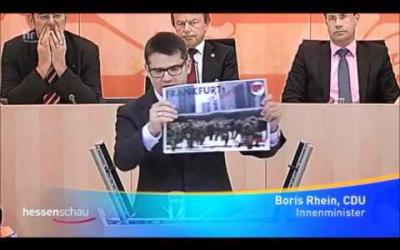
“We have fought hard to ensure that the event is prohibited”: Councillor Markus Frank (CDU)
"All Germans shall have the right to resist any person seeking to abolish this constitutional order, should no other remedy be possible." Basic Law Art.20(4). After a five-hour administrative court hearing today (Sat. 12 May 2012) Frankfurt am Main's Public Order…

As expected, Frankfurt Blockupy-ban used to clear Occupy camp
The activists must "temporarily" evacuate their camp in front of the European Central Bank in Frankfurt next week. The reason for this declaration of Frankfurt's Public Order Administration is the upcoming Blockupy protests - the one's the same administration have…

Stop the neo-liberal crisis politics – dispossess the beneficiaries!
Reposted from www.stop-neoliberal-crises-politics.org (in DE, FR, IT, ES there): We are experiencing the deepest crisis of capitalism since the great depression of the 30s – and the European governments continue to pour oil on the fires! From the very beginning, some…
KEY CONCEPTS
No Results Found
The page you requested could not be found. Try refining your search, or use the navigation above to locate the post.
SERIES / SYMPOSIA
No Results Found
The page you requested could not be found. Try refining your search, or use the navigation above to locate the post.