
CRITICAL LEGAL THINKING
LAW AND THE POLITICAL
CRITICAL LEGAL THINKING
LAW AND THE POLITICAL

Greenland between a Rock and a Hard Place
Amid US President Trump’s looming take-over of Greenland and attempted coercion of Western allies to agree to this, Western liberal international lawyers and commentators are busy reaffirming Danish sovereignty over the territory. However, an anti-colonial international law intervention during this time of inter-imperial rivalry is not to stand with Denmark, but to stand on the side of the right to Greenlandic self-determination. Recent Developments on Greenland and International Law Following US President Trump’s tariff threats to European states who do not support his acquiring of Greenland, a seemingly bold joint statement was made by European allies that they stand ‘in full solidarity with the Kingdom of Denmark and the people of Greenland’. Danes have taken to the streets, marching through Copenhagen with ‘Hands Off Greenland!’ placards. International Law professor Marc Weller recently indignantly stated on the question of who owns Greenland?: ‘The Danish claim is…


ARTICLES

ECB Frankfurt Occupy camp cleared
The Occupy camp situated in Frankfurt's financial district, at the foot of the European Central Bank, was cleared this afternoon in a lightning raid, approved by the city's Administrative Court. The police admitted they had chosen a moment when the majority of…

Racism, Sexism and Swimming at the London Olympics
I've been a little taken aback this week at the level of racism against China in the British and US media, and on longer-than-usual comment threads on various friends’ facebook walls. I mean, I know that racism in sport and in the media is nothing new, and I know…

Signs From The Future
So where do we stand now, in 2012? 2011 was the year of dreaming dangerously, of the revival of radical emancipatory politics all around the world. Now, a year later, every day brings new proofs of how fragile and inconsistent the awakening was, with all of its many…

Capturing The Social Sciences: An Experiment in Political Epistemology
According to the title that identifies this panel, we are here to enter into a discussion around the productive powers of something called “critical theory”. At first sight, critique and productivity might strike anyone as being opposite terms. Isn’t critique related to a certain form of negativity? To saying “no” to power? And isn’t the demands for capitalistic “productivity” what some of us criticise, or at least attempt to do so?
The title of this panel, however, seems to put such a taken-for-granted relationship at risk. “The Productive power of critical theory”– can we think of a productive criticality? or a critical productivity? What might it mean to engage in a form of critical-productive thought and how might such engagements contribute to challenging and transforming our knowledge-practices within the social sciences and the humanities? These are some of the questions with which I will attempt to experiment in what follows.
To be sure, these questions are not new, and many researchers and thinkers in the social sciences and the humanities are becoming increasingly interested in them, to the extent that arguably none of the latest so-called turns within these fields, be it the “ontological turn”, the “practice turn”, the “affective turn” and so on, leave the question of the relation between critique and productivity untouched.

UPDATED Occupy in Frankfurt – rally against eviction
UPDATE: on 31 July 2012 Frankfurt's Lord Mayor (Oberbuergermeister) Peter Feldmann (SPD) granted cautious support to the aims of the Occupy Camp insofar as these were about initiating a dialogue about the financial system. This effectively amounts to granting a stay…

New Report Documents ‘Total Policing’ Clampdown on Freedom to Protest
[ Drawn from Netpol's own release ] A detailed new report launched today by the Network for Police Monitoring (Netpol) highlights how promises made by the police to ‘adapt to protest’ after 2009′s G20 demonstrations in London have been forgotten in a remarkably short…

Finance’s contribution to GDP – another sleight of hand?
Yesterday's publication of further dismal GDP data for the UK is an opportunity to reconsider its basis as the justification for many aspects of the current neoliberal order. Bracketing out the question of whether economic growth is a valid lodestar for any just…

Frankfurt as protest-free city? – hunger strike begins
With the swift decision to evict the Occupy camp that has spent nine months at the foot of the European Central Bank's Eurotower, the peaceful protest appears to be entering another juncture of resistance against the city authorities, who have once again shown…

Securitisation outfit fined USD125m for obtaining false credit ratings
In my previous post I asked somewhat rhetorically what else banks had felt able to do during the credit crunch if the belief had arisen that "market stability" (sc. bank survival") trumped criminal law. The U.S. Securities and Exchnage Commission ("SEC") has…

LIBOR: City absolutism and raison de marché
What's the difference between Monaco and the City of London? One is a micro-territory governed by absolute fiat, hollowed out by property speculation, gambling, and the concealment of great crimes of wealth, and the other is Monaco. In case your wondering, Monaco…

Investment Arbitration: Restricted Area
W ith a Procedural Order issued on June 26 th, an ICSID Arbitral Tribunal has made a decision concerning an amicus curiae petition filed on 23 May 2012 by an ensemble of Petitioners formed by an international NGO and four Zimbabwean indigenous communities. Reversing…
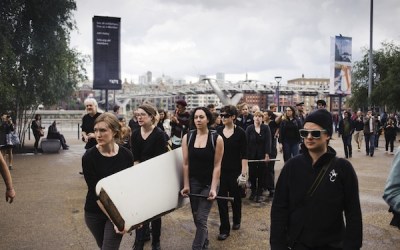
Art as Disobedience: Liberate Tate’s Gift to the Nation
This weekend was an eventful one for the Tate Modern. Late Saturday morning, pursuant to section 7 of the Museums and Galleries Act 1992, art collective Liberate Tate presented the gallery with an unexpected ‘ gift to the nation ’. That gift was a 1.5 tonne, 16.5…

What is radical in ‘radical international law’?
This article started life as a response to the call for papers for the international Workshop 'Towards a Radical International Law', held at the London School of Economics in April 2011. The call for papers started with a bold declaration: International law is a…

Terminating the spatial contract: A commentary on Greece
A very unusual thing happened on February 12th in Athens: the Greek capital city went up in flames. Now, even the casual follower of events in the country might spot something peculiar in this sentence — not with the event described, but with the statement. Is that…

Civil Disobedience — Between Symbolic Politics and Real Confrontation
Some consider civil disobedience too radical; an attempt to procure political power under the mantle of moral principles or a one-sided renunciation of the duty to obey and uphold the law, and that is not to be tolerated. Citizens in functioning democracies must limit themselves to the legally sanctioned possibilities available to them for expressing dissenting views and influencing the political process. From this perspective, civil disobedience is little more than political blackmail. Others consider it an impotent expression of a reformist yearning for cosmetic changes within the given system; as a socially permissible and harmless protest of well-intentioned citizens that remains purely symbolic and only contributes to stabilizing prevailing relationships.
This essay attempts to show that both of these widespread views fail to fully address the specific characteristics of civil disobedience as a genuinely political and democratic practice of contestation. To present these specifics in detail, it is first necessary to define civil disobedience. Second, I situate this form of political practice between the opposing poles of symbolic politics and real confrontation. In a closing remark, I briefly examine the role of civil disobedience in representative democracies.

The Greek Elections and the Change of Political Cycle in Europe
The change of cycle in Greece, and in Europe, has already begun. Despite Syriza’s narrow defeat last Sunday, the fact that a supposedly minor party could, in less than a year, manage to obtain nearly 30% of the votes, double that of the social democratic party in…

Brutality on World Refugee Day – Ireland
Yesterday another mass deportation to Nigeria took place after many Direct Provision centres were raided by the Garda National Immigration Bureau (GNIB) early in the morning. We have been informed that people including women and children were taken in Carrick-on-Suir, Cork and Portlaoise.
Out of desperation, a woman called Adekemi tried to harm herself with a knife while she was being takenfrom her room. After having dragged her outside almost naked from the waist up, the police pepper sprayed her, beat her severely, and handcuffed her in front of early age children who were visibly distraught. As she had recently undergone a serious stomach surgery, the scar opened and started bleeding while she was being beaten. Adekemi was then hospitalised, but after a short time she was brought back to the hostel, and together with her three children she was taken to the airport by the GNIB for deportation.

The Greek Crisis as Racketeering
Sociologist Charles Tilly drew a compelling analogy between the state as the place of organised means of violence, and racketeering. He defined the racketeer "as someone who creates a threat and then charges for its reduction", in order to gain control and…

Declaration: Hardt & Negri
This is not a manifesto. Manifestos provide a glimpse of a world to come and also call into being the subject, who although now only a specter must materialize to become the agent of change. Manifestos work like the ancient prophets, who by the power of their vision…

In solidarity with the Greek People
The response to the financial and economic crisis is the same everywhere: cuts in expenditure and austerity measures under the pretext of reducing deficits and the repayment of a public debt which is the direct outcome of 20 years of neoliberal policies. Governments…

The Challenges of Indignation: Spain’s 15M
The 15M [the Indignados 'movement'] is very alive, we see this in the great challenges that await it. It has many achievements, some very visible, like the creation of a different social climate or having socialized the idea that the crisis is a con, and that this…
KEY CONCEPTS
No Results Found
The page you requested could not be found. Try refining your search, or use the navigation above to locate the post.
SERIES / SYMPOSIA
No Results Found
The page you requested could not be found. Try refining your search, or use the navigation above to locate the post.